Comprehensive Speech Therapy for Children: Benefits and Insights

Why Early Speech Therapy Matters
Early speech‑language intervention sets a strong foundation for a child’s future. Research from the NIDCD and ASHA shows that children who begin therapy before age five achieve higher long‑term communication outcomes, which translate into greater confidence, smoother school readiness, and stronger social skills. Play‑based activities, visual supports, and structured practice engage children in natural contexts, making learning enjoyable while targeting articulation, language, and social‑pragmatic goals. By addressing speech, language, and even swallowing difficulties early, therapists help children master age‑appropriate vocabulary, sentence structure, and oral‑motor control, reducing frustration and fostering academic success. The combination of evidence‑based techniques and compassionate, child‑centered care ensures that early therapy not only improves speech intelligibility but also empowers children to interact confidently with peers and adults.
Benefits of Pediatric Speech Therapy for Children
Understanding Communication Disorders
Quick Reference Table
| Aspect | Details |
| Definition | Persistent difficulties producing, understanding, or using language and speech. |
| Key Characteristics | Limited vocabulary, unintelligible speech, voice/fluency issues (hoarseness, hypernasality, stuttering), social‑communication deficits. |
| DSM‑5 Classification | • Language Disorder • Speech‑Sound Disorder • Childhood‑Onset Fluency Disorder (Stuttering) • Social (Pragmatic) Communication Disorder • Unspecified Communication Disorder |
| Four Main Types | Social (pragmatic) communication disorder, language disorder, speech‑sound disorder, childhood‑onset fluency disorder (plus unspecified). |
| Five Frequently Cited Disorders | Stuttering, social (pragmatic) communication disorder, speech‑sound disorder, language disorder, mixed receptive‑expressive language disorder |
| Common Causes in Children | Developmental (genetic, brain/muscle development), acquired (prenatal toxins, injury, infection), structural (cleft palate), co‑occurring mental‑health/developmental conditions. |
Characteristics of communication disordersCommunication disorders are marked by persistent difficulties in producing, understanding, or using language and speech. Children may exhibit limited vocabulary, trouble following simple directions, or produce unintelligible speech due to sound‑production errors. Voice, resonance, and fluency problems—such as hoarseness, hypernasality, or stuttering—can also be present, affecting overall speech quality and flow. Social‑communication deficits often coexist, making reciprocal conversation challenging. Early identification and targeted therapy are essential for supporting development and academic success.What are communication disorders? These impairments affect a person’s ability to receive, send, process, or understand information through spoken, written, or other symbol systems. They can involve hearing, language, speech, or a combination of these skills, ranging from mild to profound, and may be developmental or acquired due to injury, illness, or environmental factors. When severe, they limit everyday communication, learning, and social participation.Communication disorders (DSM‑5) The DSM‑5 classifies them as neurodevelopmental conditions: language disorder, speech‑sound disorder, childhood‑onset fluency disorder (stuttering), and social (pragmatic) communication disorder, plus an unspecified category. Early evaluation by licensed speech‑language pathologists improves functional outcomes.What are the four types of communication disorders? Social (pragmatic) communication disorder, language disorder, speech‑sound disorder, childhood‑onset fluency disorder, and unspecified communication disorder.What are the five communication disorders? Stuttering, social (pragmatic) communication disorder, speech‑sound disorder, language disorder, and mixed receptive‑expressive language disorder.Causes of communication disorders in children
Causes include developmental factors (genetic abnormalities, brain or muscle development issues), acquired factors (prenatal toxin exposure, brain injury, infections), structural anomalies (cleft palate), and co‑occurring mental‑health or developmental conditions. Early identification by pediatric speech‑language pathologists is critical for effective intervention.
Recognizing When to Seek Help
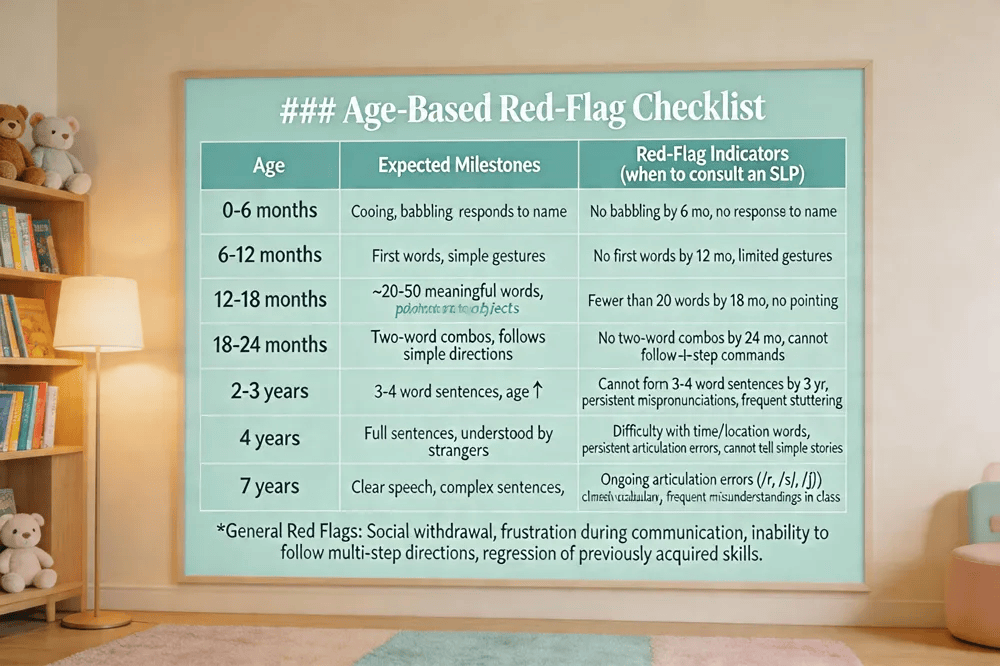
Age‑Based Red‑Flag Checklist
| Age | Expected Milestones | Red‑Flag Indicators (when to consult an SLP) | |—|—|—| | 0‑6 months | Cooing, babbling, responds to name | No babbling by 6 mo, no response to name | | 6‑12 months | First words, simple gestures | No first words by 12 mo, limited gestures | | 12‑18 months | ~20‑50 meaningful words, points to objects | Fewer than 20 words by 18 mo, no pointing | | 18‑24 months | Two‑word combos, follows simple directions | No two‑word combos by 24 mo, cannot follow 1‑step commands | | 2‑3 years | 3‑4 word sentences, age ↑ | Cannot form three‑ to four‑word sentences by 3 yr, persistent mispronunciations, frequent stuttering | | 4 years | Full sentences, understood by strangers | Difficulty with time/location words, persistent articulation errors, cannot tell simple stories | | 7 years| Clear speech, complex sentences, classroom participation | Ongoing articulation errors (/r/, /s/, /ʃ/), limited vocabulary, frequent misunderstandings in class |General Red Flags: Social withdrawal, frustration during communication, inability to follow multi‑step directions, regression of previously acquired skills. |
Early identification of communication difficulties is essential for a child’s long‑term success. The National Institute on Deafness and Other Communication Disorders notes that nearly 1 in 12 U.S. children experience a speech, language, voice, or swallowing disorder, and early intervention dramatically improves outcomes.
When to consult speech therapy for a toddler– If a toddler has fewer than 20 meaningful words by 18 months, does not combine two words by age 2, or cannot form three‑ to four‑word sentences by age 3, an evaluation is warranted. Persistent mispronunciations, frequent stuttering, or difficulty following simple directions also signal the need for a speech‑language pathologist.When should a child be referred for speech therapy?– Referral should occur as soon as consistent delays appear: no babbling by six months, missing first words by 12‑18 months, limited vocabulary at age 2, or trouble with two‑ or three‑word sentences by age 3. Frustration or social withdrawal during communication are additional red flags.Does my child need speech therapy at age 4?– A 4‑year‑old should use longer, grammatically correct sentences and be understood by strangers. Difficulty with time or location words, persistent articulation errors, or an inability to tell simple stories indicates a need for evaluation.Does my child need speech therapy at age 7?– By age 7 most children speak clearly and use complex sentences. Ongoing articulation errors (e.g., /r/, /s/, /ʃ/), limited vocabulary, or frequent misunderstandings in class suggest a professional assessment is still beneficial.Is 18 months too early for speech therapy? – No. Early intervention at 18 months is encouraged; clinicians assess milestones such as pointing, following commands, and using true words, and they can provide play‑based strategies to boost communication while the brain is highly plastic.
A comprehensive speech‑language evaluation includes a parent interview, play‑based observation, and standardized tests (e.g., Preschool Language Scales‑5, Goldman‑Fristoe Articulation). Results guide an individualized plan that may involve articulation drills, language expansion, fluency shaping, or oral‑motor exercises.
If any of the above signs are present, schedule an appointment with a licensed pediatric speech‑language pathologist—such as those at Pediatric Communication Solutions in Oklahoma City—so your child can receive the support needed to thrive.
Therapy Techniques and Home Resources
Common Speech‑Therapy Techniques & Home Strategies
| Technique | Core Idea | Example Home Activity |
| Modeling & Repetitive Practice | Therapist demonstrates target sound/word; child repeats. | Parent says “b‑ball” while holding a ball; child repeats. |
| Articulation Cards / Picture Cues | Visual prompts for specific phonemes. | Use picture cards for “cat,” “dog,” “sun” to practice /k/, /d/, /s/. |
| Oral‑Motor Drills | Strengthen muscles for speech production. | Bubble blowing, straw drinking, tongue‑in‑gum‑out exercises. |
| Language‑Stimulation Games | Encourage vocabulary & sentence building. | “I Spy” with adjectives, storytelling dice. |
| Visual & Auditory Prompts | Support comprehension & production. | Use visual schedules; clap before the child repeats a word. |
| Shaping & Positive Reinforcement | Gradually increase complexity, reward effort. | Give stickers for each correct utterance, increase word length weekly. |
| Parent‑Friendly PDFs | Structured printable activities. | “25 Speech & Language Strategies” checklist; printable articulation worksheets. |
What are common speech‑therapy techniques? Speech‑language pathologists begin with modeling and repetitive practice of target sounds, using articulation cards or picture cues. Oral‑motor drills—blowing bubbles, straw drinking, tongue‑in‑tongue‑out strengthen the muscles for clear speech. Language‑stimulation activities such as word games, storytelling, and interactive play encourage functional vocabulary and sentence building. Visual and auditory prompts, shaping, and positive reinforcement gradually increase independence, while structured step‑by‑step sessions promote generalization across settings.25 speech and language strategies PDF The “25 Speech & Language Strategies” PDF is a concise, parent‑friendly guide covering self‑talk, parallel talk, repetition, visual supports, sign language, modeling, and interactive routines. Each strategy includes a brief explanation, practical example, and a checklist for tracking progress. It can be downloaded from the Speech‑and‑Language‑at‑Home website and is often incorporated by Pediatric Communication Solutions for daily home practice.Speech therapy activities PDF
Free printable activity PDFs are available from reputable sources: SLK Curriculum’s 7‑day trial offers goal‑aligned sheets for articulation, phonology, and motor speech; the Durand Institute provides play‑based homework packets with bubbles, books, and puzzles; and the Texas Children’s Health Plan supplies “Ideas for Speech Encouragement” sheets organized by age. These PDFs are easily printable and can be customized to match each child’s therapy goals.
Special Populations: Autism and Social Communication
Autism‑Focused Communication Supports
| Focus Area | How It Helps | Practical Example |
| Expressive Language Development | Increases verbal output and functional vocabulary. | Use picture‑exchange communication system (PECS) to label objects, then transition to spoken words. |
| Social‑Pragmatic Skills | Improves turn‑taking, eye contact, conversational structure. | Role‑play greeting cycles: “Hi, my name is ___; what’s your name?” |
| Non‑Verbal Communication | Enhances facial expression & body language awareness. | Mirror‑play: child mimics therapist’s facial expressions. |
| Classroom Participation | Reduces barriers to instruction comprehension. | Teachers provide visual schedules, simplified language, and regular comprehension checks. |
| Therapist Role | Conducts play‑based evaluation, creates individualized plan, models strategies, monitors progress. | Therapist uses modeling + repetition during a play activity, then gives a home‑practice sheet. |
Speech therapy benefits for autism Speech‑language therapy helps autistic children develop expressive language, using verbal words, as like picture alternative gestures and gestures or gestures or. engage. supports enhances of spoken language, facial expressions, and body language, enabling appropriate responses. Therapy teaches turn‑taking, eye contact, and conversational structure, which supports friendships and smoother peer interaction. Early, individualized services expand vocabulary and sentence‑building skills, fostering independence at home, school, and in the community.Communication disorders in the classroom In classrooms, speech, language, or augmentative‑communication needs can hinder instruction comprehension and social participation. Teachers can use visual supports, simplified language, and regular comprehension checks. Collaboration with licensed speech‑language pathologists provides individualized strategies, such as tailored prompts or AAC tools, ensuring the child can engage fully and reduce frustration.How does a speech‑language therapist help a child? The therapist conducts a play‑based evaluation, gathers parent input, and uses standardized tests to identify articulation, language, fluency, voice, or swallowing challenges. An individualized plan then incorporates play‑based activities, modeling, repetition, and visual cues to teach correct sound production, expand vocabulary, improve sentence structure, and strengthen listening skills. Progress is monitored, and home practice is recommended for generalization.What are common speech‑therapy techniques? Techniques include modeling target sounds, repetitive drills with articulation cards, oral‑motor exercises (e.g., blowing bubbles), language‑stimulation games, visual and auditory prompts, shaping, and positive reinforcement. Structured, step‑by‑step practice promotes skill retention and transfer to everyday settings.
Local Resources and Services in Oklahoma City
Oklahoma City Speech‑Language Service Providers
| Provider | Services Offered | Contact |
| Pediatric Communication Solutions (PCS) | Infant‑toddler speech therapy, in‑home & clinic sessions, tele‑practice. | (405) 555‑1234 • pcs‑ok.com |
| Small Steps Pediatric Therapy | Outpatient speech, language, feeding, occupational therapy; comprehensive evaluations. | (405) 555‑5678 • smallstepsokc.com |
| Endeavers Pediatric Therapy Services | Speech‑language and occupational therapy; community‑focused. | (405) 555‑9012 • endeavourspts.com |
| Uplift Therapy Center | Pediatric speech therapy, parent workshops, school‑based support. | (405) 555‑3456 • uplifttherapycenter.com |
| Wooster Community Hospital HealthPoint (Ohio) | Pediatric speech‑language evaluation & treatment (reference for out‑of‑state families). | (330) 202‑3300 • woosterhealthpoint.org |
Pediatric speech therapy is a specialized branch of speech‑language pathology that helps children develop the ability to understand and use language, articulate sounds, and communicate effectively. Licensed SLPs assess each child’s strengths and challenges and create individualized, play‑based treatment plans that may target articulation, language comprehension, social communication, feeding, swallowing, or AAC devices. Early, evidence‑based practice builds confidence and supports academic and social success.
Baby speech therapist– A baby speech therapist is an SLP who works with infants and toddlers, using gentle, play‑based techniques to encourage vocalizations, oral‑motor skills, and early language comprehension. At Pediatric Communication Solutions (PCS) in Oklahoma City, certified therapists offer in‑home and clinic sessions tailored to each baby’s developmental stage, preventing later delays and fostering parent‑child bonding.Small Steps Pediatric Therapy– Small Steps is a community‑focused outpatient clinic that provides evidence‑based speech‑language and occupational therapy for children. Their client‑centered approach includes comprehensive evaluations, therapy for speech, language, feeding, and daily‑living skills, and collaboration with medical specialists to create personalized plans.Pediatric Communication Solutions – Contact Information– Pediatric Communication Solutions can be reached at (405) 555‑1234 or via pcs‑ok.com for a free initial consultation. They accept most major insurers and offer tele‑practice options.Wooster Community Hospital HealthPoint– The Wooster Community Hospital HealthPoint facility in Wooster, Ohio provides comprehensive pediatric speech‑language evaluation and treatment for articulation, language, fluency, and swallowing disorders. Parents can schedule appointments by calling (330) 202‑3300 or using the online request form.Other regional providers and referral options – Oklahoma City families can also access services through Endeavers Pediatric Therapy Services, Uplift Therapy Center, and local school‑based speech‑language programs. Pediatricians can provide referrals, and many insurers cover early‑intervention services when a qualified SLP conducts a thorough evaluation.
Building a Brighter Future Through Speech Therapy
Early intervention is the cornerstone of successful speech‑language outcomes; children who begin therapy before age five show significantly higher gains in vocabulary, articulation, and social confidence (NIDCD; ASHA). By acting now, families tap into evidence‑based tools such as play‑based activities, visual supports, and parent‑guided home practice that reinforce skills across home, school, and community settings. Helpful resources include the Wooster Community Hospital HealthPoint clinic (call (330) 202‑3300), Endeavors Pediatric Therapy Services in Oklahoma City, and Pediatric Communication Solutions, all of which offer pediatric speech‑language pathologists, flexible scheduling, and tele‑practice options. Next steps: obtain a pediatrician referral, request a comprehensive speech‑language evaluation, and discuss individualized goals with a licensed SLP; early assessment paves the way for a brighter, more communicative future for their child.