Apraxia Speech Therapy: Helping Children Communicate Better
Understanding Childhood Apraxia of Speech
Childhood Apraxia of Speech (CAS) is a neurological motor‑planning disorder. The brain knows what a child wants to say but has difficulty sequencing the precise movements of tongue, lips, jaw and palate for clear speech. CAS affects about 1‑2 per 1,000 children in the U.S. and is usually identified between ages 2 and 5, after delayed babbling or first words. Core signs are inconsistent sound errors, lengthened syllable transitions, and atypical prosody such as misplaced stress. Over 95 % of children with CAS also have expressive language delays, and many show feeding or fine‑motor challenges. Early, comprehensive assessment by a licensed SLP is essential because intensive cue‑based therapy works best while neural plasticity is, promoting faster gains in intelligibility and confidence.
Speech Therapy Techniques Childhood Apraxia of Speech
Early Identification, Typical Speech Patterns, and Treatment Foundations
Early signs of CAS before age two include limited babbling, quiet vocal play, and inconsistent word production—children may say a word differently each attempt, omit final consonants, or produce vowel distortions. Example: “bababa” for “banana,” “BUH‑nan‑UH” for “buh‑NAN‑uh,” or “duh” for “duck.” The treatment hierarchy starts with a comprehensive assessment, then intensive motor‑learning techniques such as Dynamic Temporal and Tactile Cueing (DTTC) that use visual, tactile, and auditory cues. After establishing basic movement patterns, therapy shifts to functional speech practice, cue fading, and finally generalization across partners and settings. Intensive individualized therapy—3‑5 one‑on‑one sessions per week—focuses on repeated syllable, word, and phrase practice, prosody, and auditory discrimination, with parents coached for daily home practice. For more resources, visit Pediatric Communication Solutions’ CAS page, which offers evidence‑based information, video tutorials, and appointment scheduling. These services are provided by licensed SLPs in Oklahoma City and surrounding areas, ensuring comprehensive, child‑centered care.
Evidence‑Based Therapeutic Approaches for All Ages

Effective therapy for childhood apraxia of speech (CAS) relies on intensive, multisensory motor‑learning techniques. Evidence‑based methods such as Dynamic Temporal and Tactile Cueing (DTTC), Rapid Syllable Transition (ReST), and PROMPT provide visual, auditory, and tactile prompts that guide accurate speech movements. High‑frequency practice—often 30‑45 minutes, three to five times per week—produces rapid gains in intelligibility.
What is the most effective treatment for apraxia of speech? Personalized, intensive speech‑language therapy that emphasizes motor planning is most effective. DTTC and ReST, delivered in one‑on‑one sessions with frequent feedback and cue fading, yield the strongest outcomes.Apraxia speech therapy activities Use action‑imitation games, functional sound drills with familiar objects, core‑vocabulary picture books, and rhythmic techniques (clapping, tapping) to develop prosody and sequencing.Treatment for apraxia of speech in adults Adult therapy blends intensive motor‑planning drills, auditory‑feedback, and multimodal cueing, often supplemented by AAC devices and group practice to support real‑world communication.Adult speech therapy OKCPediatric Communication Solutions in Oklahoma City offers adult speech‑language services, providing individualized plans, telehealth options, and interdisciplinary collaboration for stroke, TBI, Parkinson’s, and aphasia.Speech pathways OKC Speech Pathways (8007 NW 122nd St., OKC) delivers child‑centered, evidence‑based CAS therapy using DTTC, PROMPT, and ReST, with family coaching and flexible in‑person or virtual sessions.
Family‑Centered Communication Tools and Positive Interaction
Effective parent‑child communication is a cornerstone of successful speech‑language therapy. Parents can download two free PDFs from the Pediatric Communication Solutions website: the “Parent‑Child Communication” guide, which includes developmental norms, language strategies, and activities such as “Special Time” and face‑to‑face positioning; and the “Effective Communication with Children” guide, which walks caregivers through attention, vocabulary, sentence building, storytelling and conversation with picture‑card ideas and open‑ended prompts. Positive communication means using warm, encouraging language—praise specific effort (“I see you tried hard”), employ door‑opener statements (“Tell me more”), and frame requests as “do” statements rather than “don’t” commands. Practical tips to make children feel valued include getting down to eye level, reflecting back what the child says, offering choices, and using visual supports like stickers or charts. By creating a distraction‑free, judgment‑free environment and practicing active listening, families reinforce confidence, improve language skills, and support the child’s overall communication development and emotional wellbeing throughout daily life and social interaction.
School‑Based Support and Community Resources
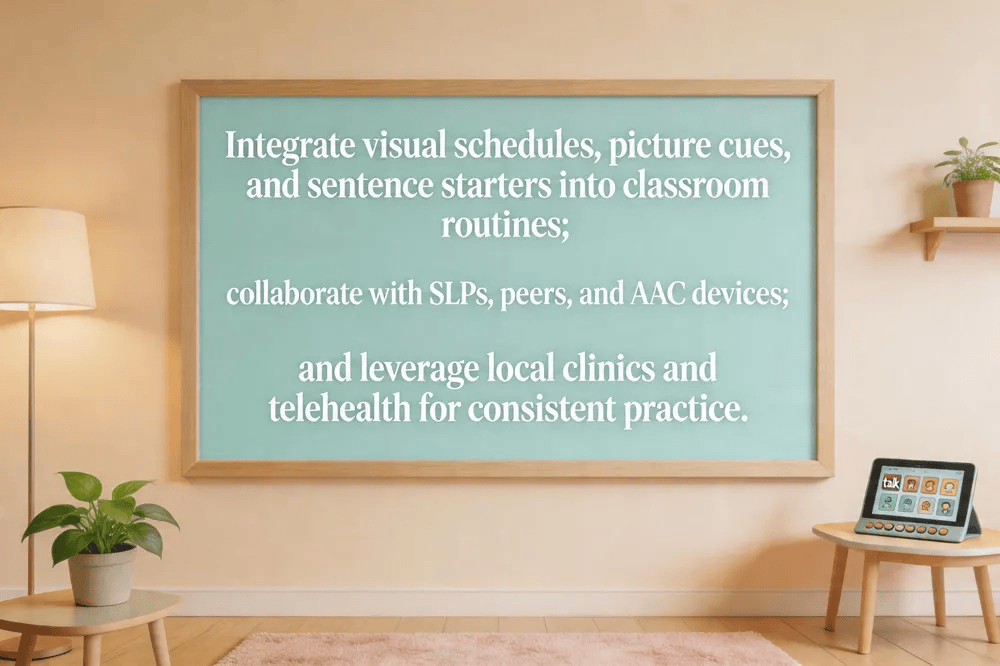
Integrating speech goals into classroom routines begins with a clear communication plan: visual schedules, picture cues, and chunked directions help children with CAS stay on task and understand expectations. Teachers are coached to model correct speech, expand on child attempts, and use sentence starters on the board, creating a language‑rich environment that reinforces therapy targets. Collaboration with school speech‑language pathologists (SLPs) ensures that individualized goals are woven into daily lessons, while peer modeling and supportive technology such as augmentative and alternative communication (AAC) devices promote participation across subjects.
In Oklahoma City and nearby towns, families can access evidence‑based pediatric speech therapy at clinics like Pediatric Communication Solutions (Elgin and Edmond), Speech Pathway, and Sensational Kids, which offer one‑on‑one, small‑group, and telehealth options. Group sessions provide social interaction and motivation, whereas telepractice delivers intensive, high‑frequency practice when in‑person visits are challenging. These community resources, combined with coordinated school support, give children the consistency and reinforcement needed to build confidence, improve intelligibility, and succeed academically and socially.
Screening, Professional Directories, and Specialized Resources
Quick assessment for apraxia of speech PDF The Quick Assessment of Apraxia of Speech PDF is a brief, clinician‑friendly screening tool that presents a short set of speech tasks, cue‑checking items, and a scoring guide. It can be completed in a single session and helps determine whether a full diagnostic evaluation is needed. Families in Oklahoma City can obtain a printed copy from Pediatric Communication Solutions during an initial consultation or download it from reputable online repositories.Apraxia speech therapist near me For Oklahoma City residents, specialized apraxia therapy is available at Pediatric Communication Solutions (E. Britton Rd.), John W. Keys Speech and Hearing Center (Beth Lane), and Speech Pathway (Stephanie Warman, Kylie Hilliard, Emily Hathaway). Telepractice options include Breanna Waldrup and Sarah Baker of Baker Speech Clinic, all CCC‑SLP‑credentialed and accepting most insurance plans.Apraxia exercises for adults PDF A free downloadable PDF provides adult‑focused exercises: breath‑support drills, sound‑sequencing activities, motor‑learning tasks, word lists, and printable cue cards. The program follows evidence‑based principles—high trial numbers, variable practice, and immediate feedback—to promote accurate speech planning.Childhood apraxia of speech Parent handout Our printable handout, “Understanding Childhood Apraxia of Speech,” offers a concise overview of CAS, signs, therapy techniques, home‑practice tips, and FAQs. It is designed for parents, teachers, and caregivers to support consistent communication goals.OU speech Pathology degree sheet The University of Oklahoma’s Department of Communication Sciences and Disorders offers MA, MS, and Ph.D. programs in Speech‑Language Pathology, accredited by ASHA’s Council on Academic Accreditation. Graduates complete clinical experiences at OU Health Sciences Center and achieve a 100 % pass rate on the Praxis exam, preparing them for careers in schools, hospitals, and private practice.
Integrating Technology, AAC, and Multidisciplinary Care
Modern apraxia therapy in Oklahoma City blends high‑tech AAC tools, collaborative medical teams, and flexible telehealth. Speech‑language pathologists use speech‑generating tablets and visual cueing apps to give real‑time pronunciation feedback while reinforcing motor‑planning drills. Pediatric Communication Solutions coordinates with pediatricians, occupational therapists, and feeding specialists to address co‑occurring language, motor, and sensory needs, ensuring a unified care plan. Remote practice via video‑modeling and interactive games lets families sustain the intensive, high‑frequency practice that research shows improves intelligibility. Looking ahead, SLPs are pursuing advanced training in DTTC, PROMPT, and ReST protocols, while clinics expand tele‑therapy platforms and integrate data‑driven outcome tracking.
Pediatric Communication Solutions– a licensed, ASHA‑accredited clinic on E. Britton Road that offers individualized speech, language, feeding, and learning services, collaborating closely with medical specialists.Apraxia speech therapist near me– Pediatric Communication Solutions, John W. Keys Speech and Hearing Center, Speech Pathway, and virtual providers Breanna Waldrup and Sarah Baker.Speech pathways OKC– 6905 NW 122nd St., offering evidence‑based therapy, group programs, and telepractice.Adult speech therapy OKC– Pediatric Communication Solutions also provides adult services for articulation, fluency, voice, dysphagia, and cognitive‑linguistic therapy, with telehealth options.Child apraxia treatment website – https://www.pediatriccommunicationsolutions.com/children-apraxia, featuring free CEU‑eligible webinars, DTTC resources, and appointment scheduling.
Moving Forward with Confidence and Clarity
Evidence‑based interventions for childhood apraxia of speech include DTTC, PROMPT, ReST, and NDP3®. These approaches use intensive, repetitive practice of functional words with visual, tactile, and auditory cueing, and cue fading to build accurate motor plans. Success depends on family‑school partnerships: parents reinforce targets at home, teachers embed speech goals into routines, and both share progress with the SLP. In Oklahoma City, families can download free PDFs from the Once Upon a Time Foundation, explore resources at Pediatric Communication Solutions, and schedule evaluations with licensed SLPs at Speech Pathway, OPTC, or Sensational Kids. Early, frequent practice—three to five sessions weekly—maximizes neural plasticity and significantly improves intelligibility.