
Child Communication Therapy: Methods to Enhance Speech
The Importance of Early Speech and Language Development
Early Speech Milestones
From birth to around two years, children begin to develop speech through babbling, producing simple sounds like ‘ma,’ ‘da,’ and ‘ba.’ Caregivers can encourage this crucial stage by talking to infants, responding to their vocalizations, and using gestures such as waving or pointing. These interactions support foundational communication skills.
Role of Speech-Language Pathologists
Speech-language pathologists (SLPs) specialize in assessing and treating speech and language difficulties in children. They identify delays or disorders early, create tailored therapy plans, and work collaboratively with families to promote speech clarity, vocabulary growth, and social communication skills. Early intervention by SLPs significantly improves outcomes, minimizing long-term challenges.
Impact of Speech Delays on Learning and Socialization
Children with speech and language delays often face difficulties in academic settings and social interactions. Delays may result in limited vocabulary, trouble forming sentences, or shyness in communication, which can affect confidence and peer relationships. Addressing these challenges early supports better learning, emotional development, and social integration, reducing frustration and enhancing overall quality of life.
Teach a Child to Talk with 5 Strategies from Speech Therapist …
Foundations of Early Speech Development and Caregiver Role
How can caregivers encourage early speech development in infants?
Caregivers play an essential role in fostering early speech development babbling and language growth. From infancy, they can encourage babies to vocalize simple babbling sounds such as Vocalizing Sounds Like ‘ma,’ ‘da,’ ‘ba’. Responding promptly to these sounds by imitating them and engaging in Back-and-Forth Infant Conversations helps strengthen foundational communication skills.
Infant babbling sounds
Early babbling is one of the first steps towards meaningful speech. When a baby produces sounds, caregivers should respond warmly and mirror these attempts. This not only reinforces vocal experimentation but also promotes social and emotional bonding as part of Responsive conversation and sound imitation.
Responsive communication and eye contact
Making eye contact while interacting supports attention and connection — key components of effective communication. Caregivers should also respond to infants’ facial expressions and laughter, creating positive feedback loops that motivate ongoing communication efforts, modeled in Talking and responding to infants.
Use of gestures
Incorporating non-verbal methods such as waving goodbye or pointing assists infants in understanding language beyond spoken words. These gestures support receptive language skills and serve as an important bridge toward verbal communication, covered in Using gestures for communication and Non-verbal communication skills for infants.
Everyday language exposure through routines
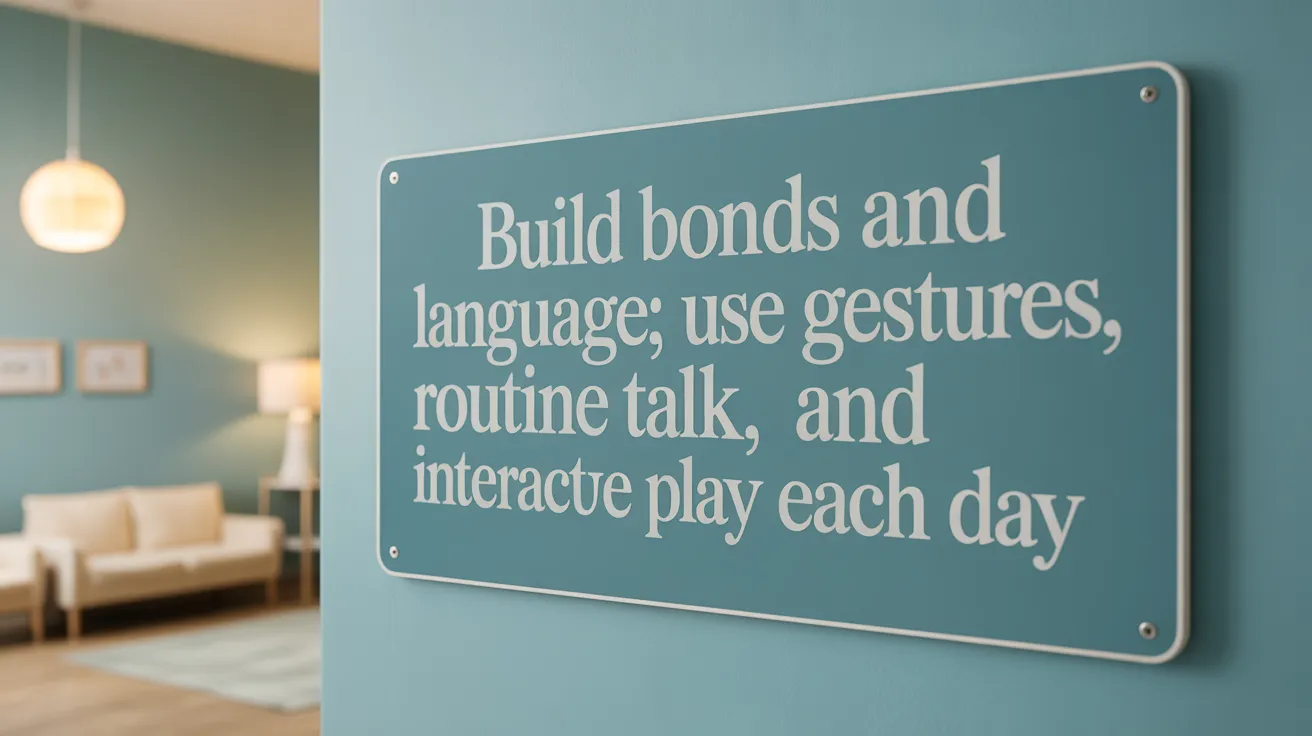
Speaking to infants continuously during everyday activities like feeding, bathing, and dressing exposes them to a variety of words and sentence structures, explained in Talking During Daily Routines. Naming objects, describing actions, and emphasizing sounds during such routines promote natural language comprehension and expressive skills.
Reading and interactive play benefits
Engaging children with colorful picture books and discussing images helps build vocabulary and encourages early literacy as described in Reading to Children and Discussing Pictures. Additionally, interactive play — including Singing nursery rhymes or playing simple question games — introduces rhythm and syntax, essential for language development.
By integrating these strategies in daily interactions, caregivers offer rich linguistic environments where infants can confidently build communication skills that are foundational for later speech and language milestones.
Diagnosing and Addressing Speech and Language Disorders in Children

What are common speech disorders in children and how are they identified?
Common speech disorders in children include articulation disorders, where children have trouble producing specific sounds correctly; stuttering, characterized by repetitions or prolongations of sounds; language disorders affecting understanding and use of language; and voice disorders, which impact vocal quality.
Signs and Risk Factors for Communication Delays
Signs that a child may have a speech or language delay include a limited vocabulary for their age, trouble forming sentences, hesitation or avoidance of speaking, and poor comprehension of spoken language. Additional signs can be persistent hoarseness or a nasally voice.
Risk factors increasing the likelihood of communication delays comprise a family history of speech issues, recurrent ear infections which can affect hearing, and premature birth. Awareness of these indicators can prompt parents and caregivers to seek timely assessments.
The Importance of Early Intervention
Early intervention is crucial for effective outcomes in children with speech and language difficulties. Research shows that beginning therapy before school age maximizes developmental gains and supports academic, social, and emotional success. Interventions tailored to the child’s needs provide targeted support to improve communication skills. For more information, see Early intervention for communication delays.
Role of Licensed Speech-Language Pathologists
Licensed speech-language pathologists (SLPs) play a central role in diagnosing and treating communication disorders. They conduct comprehensive evaluations including speech sound production, language comprehension, and oral motor functions. Based on findings, SLPs create individualized therapy plans, employing evidence-based techniques to address articulation, fluency, voice, and language challenges. Learn more about Child Speech and Language.
In collaboration with families, educators, and healthcare providers, SLPs ensure ongoing monitoring and adjustments to therapy, promoting generalization of skills across settings. Early access to skilled professionals facilitates quicker improvement and fosters children’s confidence and participation in daily life. For effective approaches, see Speech Therapy Strategies.
Effective Speech Therapy Techniques and Approaches for Children

What speech therapy techniques are effective for children?
Speech therapy for children employs a variety of techniques tailored to address specific speech and language challenges, fostering communication development in a supportive and engaging manner.
Articulation Therapy focuses on improving clarity in speech by helping children produce individual sounds correctly. Therapists use targeted exercises to practice sounds in isolation, syllables, words, and sentences, enhancing pronunciation and intelligibility. Learn more about Articulation Therapy for Kids.
Play-Based Therapy integrates speech practice naturally through toys, games, and pretend scenarios. This approach makes therapy enjoyable and effective, encouraging children to use language spontaneously in interaction. Find out more about Play-Based Speech Therapy.
Language Expansion involves modeling and repeating children’s utterances with extensions. For example, if a child says “dog,” a therapist might respond with “Yes, the big brown dog,” promoting richer vocabulary and more complex sentence structure. Explore Expanding Toddler Language techniques.
Fluency Shaping techniques assist children who stutter by teaching strategies such as slow, controlled speech and smooth transitions between sounds, reducing disfluencies and building confidence. Read about Fluency Therapy for Children.
Voice Therapy targets vocal quality, pitch, and breath control. Exercises like diaphragmatic breathing and vocal warm-ups improve voice strength and clarity, especially for children with voice disorders. Learn about Voice and Resonance Therapy.
Use of Visual Aids and Gesture Support enhances comprehension and expression. Flashcards, pictures, and gestures such as pointing or waving provide multisensory learning opportunities, supporting both verbal and nonverbal communication. More on Visual Aids and Gesture Use.
Together, these evidence-based methods create a comprehensive therapy plan that adapts to each child’s individual needs, making communication development an attainable and rewarding journey. For additional detailed insights, visit Effective Pediatric Speech Therapy Techniques.
Incorporating Communication-Enhancing Activities into Daily Life
How can daily activities support a child’s speech and language development?
Daily routines are excellent opportunities to naturally boost children’s speech and language skills. Simple activities like Using grocery shopping for language learning or Mealtimes as language opportunities invite children to hear and use new words related to foods, colors, and numbers, enhancing their practical vocabulary and sentence-building abilities.
Categorization and questioning games during play or daily tasks help children learn to group items and understand choices. Play the yes-no game or choice questions encourages comprehension and expressive skills, building foundational communication.
Singing nursery rhymes introduces children to rhythm, rhyme, and sentence patterns in a fun, memorable way. This helps develop phonological awareness and encourages vocalization.
Encouraging children to describe objects they see or tell stories about their day fosters narrative skills, which are essential for expressive language and social communication.
By integrating these Activities to Encourage Speech and Language Development into everyday life, caregivers create a stimulating and supportive environment that nurtures language development naturally and joyfully.
Therapeutic Communication Strategies to Enhance Interaction and Therapy Outcomes
What communication strategies improve effectiveness in pediatric speech therapy?
Effective therapeutic communication techniques is fundamental to successful pediatric speech therapy. Building trust and rapport begins with demonstrating empathy, respect, and a nonjudgmental attitude. When children feel understood and supported, they are more likely to engage actively in therapy.
Active listening plays a crucial role by involving focused attention, reflective responses, and open-ended questions. This approach encourages children to express themselves and helps therapists better understand each child’s unique needs. Empathy is woven throughout, creating a safe space for communication.
Nonverbal cues, such as maintaining appropriate eye gaze communication, nodding, and open body language, reinforce spoken words and help establish rapport. These gestures also provide subtle feedback to the child that their message is being received and valued.
Positive reinforcement and motivation are powerful tools to promote participation and build confidence. Praising attempts, acknowledging improvements, and using rewards foster a motivating atmosphere that encourages children to practice and improve their communication skills.
Family involvement is equally important. Encouraging parents and caregivers to participate in therapy sessions and continue strategies at home helps generalize skills beyond the clinical setting. This collaborative approach supports consistent progress and integrates language development within everyday interactions.
Together, these communication strategies create a compassionate, engaging, and effective therapy environment that supports children’s speech and language growth.
Addressing Complex Cases: Multidisciplinary and Augmentative Approaches
How are complex speech and communication challenges managed in children?
Children facing developmental delays, hearing impairments, or oral-motor deficits require a comprehensive, multidisciplinary approach for effective communication development.
Multidisciplinary Interventions
Healthcare teams often include speech-language pathologists, audiologists, occupational therapists, medical specialists, and educators working collaboratively. Early fitting of hearing amplification devices such as hearing aids or cochlear implants is critical for children with hearing loss to maximize language development. For more details, see Early intervention for communication delays.
Augmentative and Alternative Communication (AAC)
AAC systems are carefully selected based on a child’s cognitive, sensory, and motor capabilities. These systems provide alternative means of communication through pictures, symbols, or devices to facilitate choice-making and reduce frustration. Vocabulary is tailored to be age-appropriate and diverse, focusing on supporting natural speech development alongside AAC use. Learn more at Total communication approach.
Oral-Motor and Feeding Therapy
Children with oral-motor challenges benefit from therapy aimed at safe oral feeding and improving oral motor coordination, which directly supports future speech clarity. Techniques include behavioral strategies and targeted exercises that promote muscle strength and function. Detailed information can be found at Pediatric speech therapy techniques and approaches.
Integration with Other Health Therapies
Intervention plans are customized to address each child’s unique developmental level and medical needs. Coordinated care may include therapies for physical, cognitive, and emotional aspects to support holistic development.
Customizing Interventions
Therapeutic strategies evolve from directive, structured approaches to more naturalistic, child-focused methods as children develop, encouraging spontaneous communication and generalization to everyday settings. Further insights available at Early intervention for communication delays.
By tailoring interventions to individual needs and ensuring multidisciplinary collaboration, children with complex communication challenges receive targeted support to enhance their speech and language skills effectively.
Partnering with Families: Supporting Speech Development at Home
How can parents support their child’s speech therapy progress at home?
Parental involvement is vital for reinforcing the skills children learn in speech therapy exercises. Parents can integrate speech therapy exercises into everyday routines such as mealtime, bath time, and dressing, turning these moments into natural language-learning opportunities.
Engaging children in language-rich play nurtures vocabulary and conversational skills. Simple activities like singing nursery rhymes, playing categorization games, and describing objects stimulate speech development.
Incorporating sign language as an additional communication tool can effectively support toddlers and children with speech delays, enhancing their ability to express themselves while verbal skills grow.
Creating distraction-free learning environments at home fosters better concentration and strengthens parent-child bonding during speech practice, supporting more effective communication development.
Caregivers can benefit from accessing online resources, including videos and coaching platforms, which provide guidance and strategies to sustain consistent progress between professional therapy sessions. This collaborative approach between families and speech-language pathologists maximizes the child’s potential for success.
The Path Forward: Consistent, Compassionate Communication Therapy
Early, Individualized Intervention is Crucial
Starting speech and language therapy at an early age can significantly improve a child’s communication abilities. Tailored intervention plans, designed by licensed speech-language pathologists (SLPs), respond to each child’s unique needs, addressing specific speech or language challenges effectively.
The Expertise of Licensed Speech-Language Pathologists
SLPs are specially trained to evaluate and diagnose a range of communication disorders. They develop evidence-based treatment plans that support clearer speech, enhanced language comprehension, and improved social communication skills, all critical for a child’s confidence and independence.
Family Collaboration Fuels Progress
Ongoing family involvement is vital. Encouraging communication through daily routines, reading, and play maintains momentum beyond therapy sessions. Parents and caregivers acting as support partners foster a nurturing environment that builds a child’s expressive and receptive language skills.
Long-Term Impact on Social and Academic Success
Consistent, compassionate communication therapy not only enhances speech clarity but also supports emotional growth and social participation. Strong communication abilities contribute to better peer relationships and academic performance, setting a foundation for lifelong success.