Child Language Disorder: Identification and Treatment

Understanding the Landscape
Child language disorders affect roughly 7 % of preschool‑age children in the United States—about one in fourteen—making them one of the most common developmental challenges. Early identification, ideally before age five, is crucial because neuro‑plasticity is greatest during the toddler and preschool years; timely screening against milestones such as babbling by six months or two‑word phrases by two years allows intervention to begin when the brain is most receptive. Licensed speech‑language pathologists (SLPs) lead the evaluation process, ruling out hearing loss, conducting standardized assessments, and designing individualized, play‑based therapy. SLPs collaborate with families, educators, and medical specialists to embed language goals in daily routines, use augmentative communication when needed, and monitor progress toward functional communication, ultimately supporting academic success and social confidence, supporting stronger reading skills and lowering future learning gaps.
Identifying Developmental Language Disorder
What Is a Language Disorder? Types and Causes
Types and Causes of Developmental Language Disorder (DLD)
| Disorder Type | Core Features | Typical Causes / Risk Factors |
| Receptive | Difficulty understanding spoken or written language | Genetic predisposition, auditory processing deficits, limited language exposure |
| Expressive | Difficulty producing language (vocabulary, grammar, articulation) | Genetic factors, neurological injury, low socioeconomic status |
| Mixed Receptive‑Expressive | Combination of comprehension and production challenges | Strong family history, early brain injury, infections affecting language centers |
| Pragmatic | Trouble using language socially (turn‑taking, inference) | Social‑communication deficits, limited interaction opportunities |
| Phonological| Errors in sound production and patterning | Neurological anomalies, oral‑motor deficits, hearing issues (ruled out for DLD) |Key Causes of DLD–Genetic/Neurological: Family history, brain injury, stroke, infections, prenatal toxins.
- Environmental: Low socioeconomic status, limited language exposure, prenatal alcohol or drug exposure.
- Interaction: Genetics interact with environment, influencing brain development and language networks.
Developmental Language Disorder (DLD) is a neurodevelopmental condition in which a child’s ability to understand, speak, read, or write language develops more slowly than expected for age, without hearing loss, autism, or limited language exposure. It affects about 7‑8 % of school‑age children (≈1 in 14) and often persists into adulthood if untreated. Typical signs include late‑talking, limited vocabulary, frequent grammatical errors, difficulty following directions, and challenges with storytelling or figurative language. DLD arises from complex interactions between genetics and brain development; a strong family history is common, indicating a genetic component. Genetic or neurological origins can also include brain injury, stroke, or infections that damage language centers. Environmental factors—such as limited language exposure, low socioeconomic status, or prenatal toxins—further increase risk. Language disorders are categorized as receptive (difficulty understanding), expressive (difficulty producing), mixed receptive‑expressive, pragmatic (social use), and phonological (sound errors). DLD can be mistaken for autism because both involve social‑communication challenges, but autism includes repetitive behaviors and restricted interests, whereas DLD is limited to language deficits. DLD is not a form of ADHD; attention difficulties in DLD are secondary to language processing demands and do not meet ADHD diagnostic criteria.
Spotting the Signs: Early Identification and Assessment
Early Identification Milestones & Assessment Process
| Age Range | Red‑Flag Milestone | Screening Tools | Assessment Components |
| 0‑6 months | No babbling or cooing | Ages & Stages Questionnaires (ASQ) | Case history, hearing screening |
| 6‑12 months | Limited vowel sounds, no canonical babble | ASQ‑3, Preschool Language Scale‑5 (PLS‑5) | Standardized language assessment |
| 12‑24 months | < 50 words, no two‑word combos | PLS‑5, Clinical Evaluation of Language Fundamentals (CELF‑P) | Play‑based observation, parent/teacher questionnaires |
| 2‑3 years | Failure to combine words, persistent grammatical errors | ASQ‑SE, CELF‑P | Comprehensive diagnostic evaluation by SLP |
Diagnostic Steps 1.Screening – Brief checklists to flag concerns. 2. Referral – Licensed Speech‑Language Pathologist (SLP) review. 3. Comprehensive Evaluation – Case history, audiology, standardized tests, observation, questionnaires. 4. Diagnosis – Determine DLD presence and subtype (receptive, expressive, mixed). 5. Intervention Planning – Set individualized goals, involve family and interdisciplinary team.
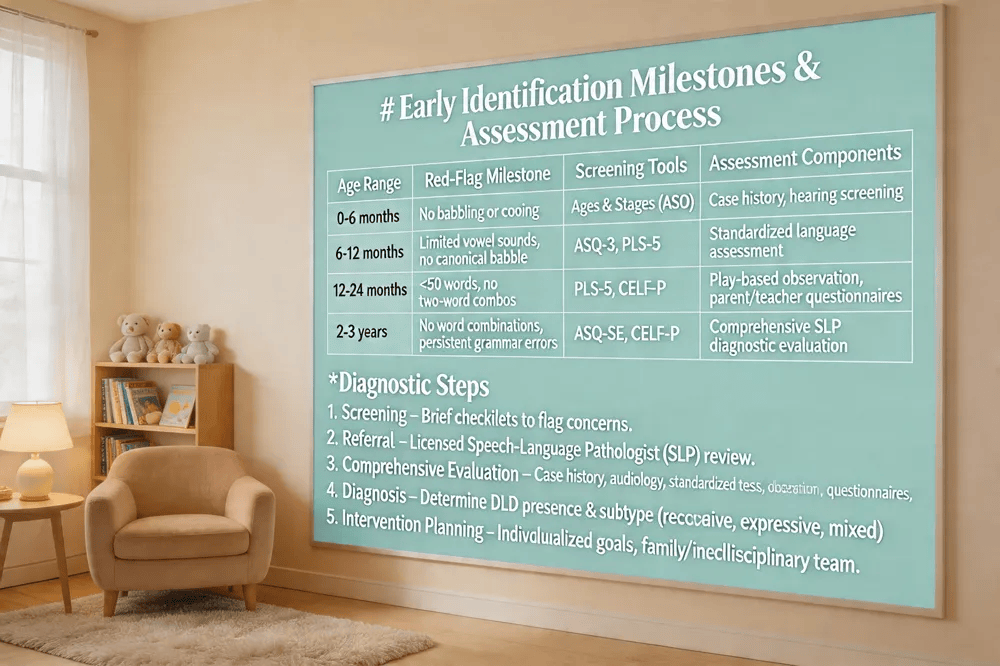
Red‑flag milestones such as a lack of babbling by 6–9 months, fewer than 50 words by 24 months, and failure to combine words into two‑word phrases by age 2 signal a possible language disorder. Professionals commonly use screening checklists like the Ages & Stages Questionnaires, the Preschool Language Scale‑5, or the Clinical Evaluation of Language Fundamentals to compare a child’s abilities with age‑appropriate norms. When a screening flags concern, a licensed speech‑language pathologist conducts a comprehensive diagnostic process: case history, hearing screening to rule out auditory loss, standardized language assessments, play‑based observation, and parent/teacher questionnaires. This evaluation determines whether the child meets criteria for Developmental Language Disorder (DLD) and identifies receptive, expressive, or mixed deficits.
Speech therapy for toddlers is a play‑based program that builds foundational communication through games, toys, and everyday routines, while coaching parents on home practice. Early intervention—delivered before age 5—leverages neural plasticity, preventing secondary academic, social, and emotional challenges, and is cost‑effective. Intervention can be delivered in the home, preschool, or via tele‑practice, and includes individualized goals, family involvement, and interdisciplinary collaboration. Early identification and therapy improve long‑term outcomes for children with language disorders.
Therapeutic Strategies: From Clinic to Home
Evidence‑Based Therapeutic Strategies
| Strategy | Typical Setting | Target Skill | Example Activity |
| Modeling & Expansion | Clinic & Home | Vocabulary & syntax | SLP models a sentence, child expands with descriptive words |
| Prompting & Recasting | Clinic | Grammar & sentence structure | SLP prompts “What did you eat?” → child says “Apple”; SLP recasts “You ate an apple.” |
| Minimal‑Pair Drills | Clinic | Articulation | Practice contrasting “bat” vs. “pat” to correct sound errors |
| Rhythmic Chanting | Home | Prosody & fluency | Sing or chant rhythmic phrases to improve speech timing |
| Visual Supports (PECS, Picture Cards) | Home & School | Pragmatic & expressive language | Use picture exchange to request objects, build sentences |
| Technology‑Assisted Games | Tele‑practice, Clinic | Vocabulary, sentence building | Interactive apps on iPad for word retrieval and story sequencing |
| Parent‑Mediated Practice | Home | Generalization across contexts | Daily 5‑minute “talk‑time” routines with structured prompts |
| AAC Devices| Clinic & Home | Functional communication for severe cases | Use speech‑generating tablets to support expressive language |Key Principles–Play‑Based: Embed learning in natural, enjoyable activities.
- Family Involvement: Coach parents for consistent reinforcement.
- Interdisciplinary Collaboration: Coordinate with educators, audiologists, occupational therapists.
- Progress Monitoring: Regular data collection to adjust goals.
Speech therapy techniques PDF– Professional bodies such as ASHA provide free downloadable PDFs that outline evidence‑based strategies (modeling, prompting, expansion, iPad‑based apps). Clinics also offer condition‑specific handouts for cleft palate, velopharyngeal dysfunction, and early‑intervention milestones.Speech therapy techniques– Clinicians blend interactive, evidence‑based methods: modeling correct speech, expanding child utterances, using minimal‑pair drills, rhythmic chanting, and visual supports (PECS, picture cards). Technology‑assisted games reinforce articulation, vocabulary, and sentence building while keeping therapy engaging.How to help a child with expressive language disorder– Model complete sentences, correct errors by recasting, expand with descriptive words, use visual cues, and provide low‑pressure turn‑taking activities (storytelling, routine narration). Consistent home practice with a licensed SLP amplifies gains.What do they do in pediatric speech therapy?– An SLP conducts a comprehensive assessment, then designs a personalized plan that may include language stimulation, articulation, fluency, pragmatic coaching, and feeding therapy. Progress is monitored and coordinated with medical and educational teams.What is the treatment for language disorder?– Individualized speech‑language therapy targets vocabulary, syntax, and comprehension using modeling, prompting, and interactive play. Parent‑mediated home practice, school collaboration, and AAC devices when needed ensure functional communication across settings.Can speech therapy help with a cleft palate?– Yes. Therapy addresses articulation, oral pressure, and hypernasality through targeted exercises, often beginning after surgical repair and coordinated with the surgical team.Speech therapy near me– In Oklahoma City, Pediatric Communication Solutions (PCS‑OK), Cleveland Clinic Oklahoma City, and Children’s Hospital Oklahoma offer licensed SLP services. Call (405) 555‑1234 or visit their websites for appointments.Pediatric speech therapy near me – PCS‑OK provides in‑clinic and telehealth sessions; the University of Oklahoma Health Sciences Center runs a pediatric clinic; many board‑certified SLPs offer home‑based services throughout the metro area. Use your insurance portal to verify coverage.
Special Considerations and Resources in Oklahoma City
Oklahoma City Resources & Considerations
| Clinic / Service | Primary Services | Contact Info | Notes |
| Pediatric Communication Solutions (PCS‑OK) | Speech‑language assessment, play‑based therapy, tele‑health | (405) 555‑1234 | Offers in‑clinic & home‑based sessions |
| Cleveland Clinic Oklahoma City | Comprehensive pediatric speech‑language services | (405) 555‑5678 | Multidisciplinary team, insurance accepted |
| Children’s Hospital Oklahoma | Diagnostic evaluations, therapy, feeding services | (405) 555‑9012 | Specialized for cleft palate & velopharyngeal dysfunction |
| Baker Speech Clinic | Early intervention, school‑based therapy | (405) 555‑3456 | Collaborative with local schools |
| Theracare Pediatric Services| Integrated speech, feeding, and occupational therapy | (405) 555‑7890 | Focus on interdisciplinary care |Early‑Intervention SLP Salary (OKC)– Typical range:$55,000 – $70,000 USD per year, based on experience, certifications, and setting.Why Early Intervention Matters
- Leverages peak neural plasticity (birth‑5 years).
- Reduces long‑term academic, social, and emotional challenges.
- Empowers parents with home‑practice strategies.
- Cost‑effective: early services often publicly funded or low‑cost for eligible families.
Getting Started
- Contact your pediatrician for a referral.
- Call one of the clinics above to schedule an initial screening.
- Verify insurance coverage through your portal.
- Begin play‑based home activities immediately while awaiting formal assessment.
Local expertise and interdisciplinary care Oklahoma City offers a network of licensed speech‑language pathologists (SLPs) who collaborate with pediatricians, audiologists, occupational therapists, and educators. Clinics such as Pediatric Communication Solutions, Baker Speech Clinic, and Theracare Pediatric Services provide comprehensive assessments, play‑based therapy, and coordinated care for children with language, swallowing, and feeding challenges.Early Intervention SLP salary In Oklahoma City, early‑intervention speech‑language pathologists typically earn between $55,000 and $70,000 USD per year, depending on experience, practice setting, and certifications.What is early intervention speech therapyEarly intervention speech therapy is a specialized service for infants and toddlers (birth‑to‑5) who show communication, language, or feeding delays. Delivered by licensed SLPs in natural settings—home, daycare, or early‑childhood classrooms—it weaves skill‑building into everyday routines, targeting listening, articulation, vocabulary, and oral‑motor abilities. Public funding often makes it free or low‑cost for eligible families.Early intervention examples Services include home‑based language‑rich activities, parent‑coach models, preschool group sessions, tele‑therapy, assistive‑technology devices, and coordinated audiology or feeding support.Why early intervention speech therapy is important
Early intervention speech therapy leverages peak neural plasticity, prevents secondary academic and social problems, and equips parents with strategies for reinforcement. Early therapy reduces long‑term service intensity, improves outcomes, and supports cognitive and emotional development.
Moving Forward with Confidence
Family involvement is the cornerstone of lasting progress. Parents and caregivers can reinforce therapy by embedding simple language activities—labeling objects, expanding short phrases, and reading aloud—into daily routines; even five minutes a day yields measurable gains. Long‑term outlook for children with language disorders is optimistic when early, intensive intervention is combined with ongoing support. Most children achieve age‑appropriate communication skills, while a minority continue to benefit from periodic booster sessions into school age. Accessing continued resources is straightforward: local early‑intervention programs, school‑based speech‑language services, and community clinics such as Pediatric Communication Solutions in Oklahoma City provide low‑cost or free therapy for eligible families. Telepractice expands reach for rural families, and parent support groups—both in‑person and online—offer shared strategies, emotional encouragement, and up‑to‑date research insights.