Effective Articulation Therapy Techniques for Early Learners

Understanding Early Articulation Therapy
Early articulation therapy is most effective when it begins before a child turns five, because the brain’s language pathways are highly plastic during this period. By age three most children have mastered sounds such as /p/, /b/, /t/, /d/, /m/ and /n/, while later‑developing sounds like /s/, /r/ and /l/ emerge through preschool. Speech‑language pathologists in Oklahoma City conduct screenings, use standardized tools such as the GFTA‑2, and design individualized plans that blend visual, auditory, and tactile cues. They coach parents to embed short, frequent practice into daily routines, monitor progress with regular intelligibility checks, and coordinate with teachers and pediatricians to ensure consistency across home, clinic, and school environments.
Articulation Speech Therapy for Kids
Core Articulation Concepts and Techniques
7 Manners of Articulation
| Manner | Description | Example Phonemes |
| Stops (Plosives) | Complete closure of the vocal tract followed by a release. | /p/, /b/, /t/, /d/, /k/, /g/ |
| Fricatives | Continuous airflow through a narrow constriction, creating turbulence. | /s/, /z/, /f/, /v/, /ʃ/, /ʒ/ |
| Affricates | A stop released into a fricative. | /ʧ/ (as in “church”), /ʤ/ (as in “judge”) |
| Nasals | Airflow directed through the nasal cavity while the oral cavity is closed. | /m/, /n/, /ŋ/ |
| Laterals | Airflow around the sides of the tongue. | /l/ |
| Trills/Flaps | Rapid vibration of articulators. | Spanish rolled /r/ (trill), /ɾ/ (flap) |
| Approximants | Articulators approach each other but do not create turbulent airflow. | /w/, /j/, /ɹ/ |
Understanding the basics of articulation sets the stage for successful therapy. What are the 7 manners of articulation? The seven main manners are: 1) Stops (plosives) – complete closure then release (e.g., /p/, /b/). 2) Fricatives – continuous airflow through a narrow opening (e.g., /s/, /f/). 3) Affricates – stop followed by a fricative (e.g., /ʧ/ as in “church”). 4) Nasals – airflow directed through the nose (e.g., /m/, /n/). 5) Laterals – airflow around the sides of the tongue (e.g., /l/). 6) Trills/Flaps – rapid vibration of articulators (e.g., Spanish “rr”). 7) Approximants – close approximation without turbulence (e.g., /w/, /j/).Articulation exercises for speech therapy– Combine structured drills with play. Sound imitation (repeating /b/, /m/, /t/), straw‑blowing for tongue‑tip placement, and word‑drill lists (e.g., “ball, bat, bunny”) are core. Games such as “Simon Says,” tongue‑twisters (“Peter Piper…”) and mirror work keep motivation high while reinforcing correct mouth shape. Short daily home sessions (10‑15 min) provide the repetition needed for motor learning.Effective articulation exercises for beginners – Start with multisensory activities that build oral‑motor strength. Lip‑purse blowing, straw bubbles, and mirror feedback help children feel the correct lip and tongue positions for /p/, /b/, /s/, /z/. Picture‑word matching (show a cat, say “/k/”) links sound to object. Fun games like “flashlight hunt” or “musical chairs” with articulation cards deliver high‑frequency practice in an engaging context.
Target Selection and Therapy Approaches
Common Therapy Approaches & Target‑Selection Strategies
| Approach | Primary Focus | Typical Duration / Frequency | Key Features |
| Developmental Sequence | Targets sounds in the order they normally appear in speech development. | 5‑16 weeks, 2‑3 sessions/week | Builds on natural acquisition patterns. |
| Complexity Approach | Starts with later‑developing, more demanding sounds to boost overall intelligibility. | 4‑12 weeks, 2‑4 sessions/week | Emphasizes high‑complexity targets early on. |
| Cycles Therapy | Rotates a set of targets (usually 3‑5) over a treatment cycle. | 5‑16 weeks, weekly cycles | Provides varied practice and prevents plateau. |
| Core‑Word Therapy | Focuses on a short list of high‑frequency functional words. | 6‑12 weeks, daily home practice (10‑15 min) | Enhances motivation and generalization to daily communication. |
| Phonological‑Process Therapy | Addresses systematic pattern errors (e.g., cluster reduction). | 8‑20 weeks, 2‑3 sessions/week | Uses minimal‑pair drills and rule‑based instruction. |
| Parent‑Mediated Modeling | Empowers caregivers to embed brief drills into routines. | Ongoing, 5‑10 min daily | Increases dosage and promotes carryover. |
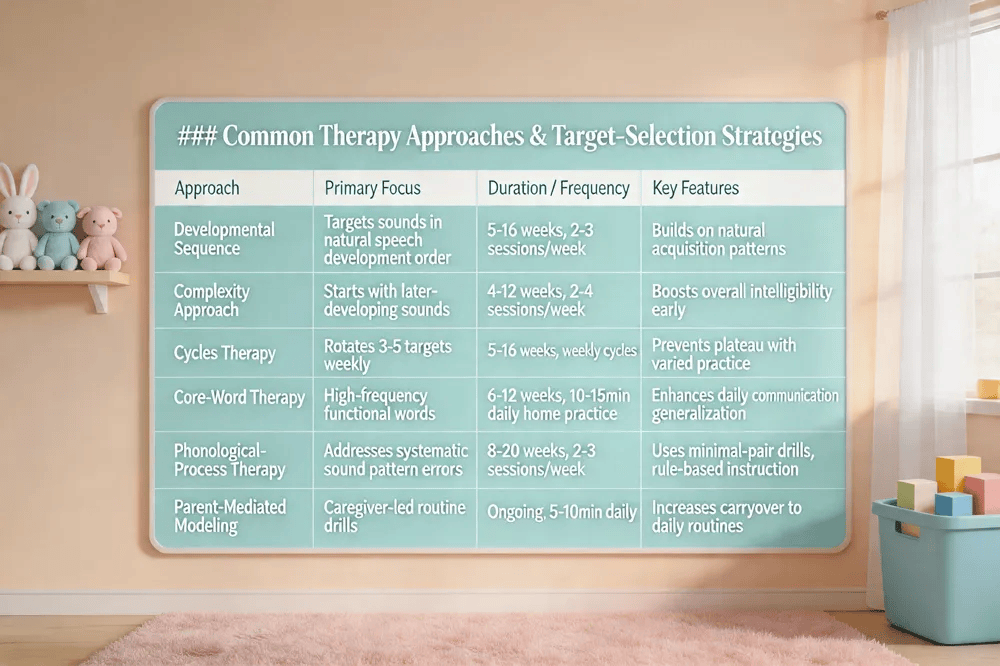
Articulation therapy for young children typically starts with motor‑based techniques: the clinician models correct tongue, lip, and jaw placement, using mirrors, tactile cues, and isolated‑sound drills that progress to words and sentences. When a child shows systematic phonemic patterns, phonological‑process therapy is added, employing auditory discrimination training and minimal‑pair (opposition) drills to sharpen the child’s ability to hear and produce the target phoneme. Evidence‑based approaches include the developmental sequence—targeting sounds in the order they normally appear in speech—and complexity approach which selects later‑developing, more demanding sounds first to accelerate overall intelligibility. Cycles therapy rotates through a set of targets over 5‑16 weeks, while core‑word therapy focuses on a short list of high‑frequency functional words, both promoting motivation and generalization. Early‑intervention techniques blend parent‑mediated modeling, play‑based enrichment (talk‑through‑play, interactive reading, songs), and visual supports to embed practice in natural routines. Starting therapy before age five leverages neuroplasticity, improves school readiness, and reduces later academic and social challenges, making early, is cost‑effective choice for families.
Practical Activities for Home and Clinic
Sample Activities for Home & Clinic Settings
| Activity | Setting | Description | Approx. Time |
| Lip‑Purse Blowing | Clinic / Home | Child purses lips and blows air to feel correct lip placement for /p/, /b/. | 2‑3 min |
| Straw Bubbles | Home | Blow bubbles through a straw to promote oral‑motor strength and breath control. | 3‑5 min |
| Mirror Feedback | Clinic / Home | Child watches mouth movements in a mirror while producing target sounds. | 5‑7 min |
| “Simon Says” (Articulation) | Clinic / Home | Game where the clinician says “Simon says say /s/” and the child imitates. | 5‑10 min |
| Flashlight Hunt | Home | Light a flashlight on objects; child names them using target phoneme (e.g., “/b/ ball”). | 4‑6 min |
| Musical Chairs with Articulation Cards | Clinic | Chairs placed in a circle; when music stops, child picks a card and says the sound. | 5‑8 min |
| Picture‑Word Matching | Home | Show a picture (e.g., cat) and have the child say the associated sound (/k/). | 3‑5 min |
| Song Fill‑Ins | Home | Sing a familiar song and pause for the child to insert target phoneme words. | 5‑10 min |
Parent‑coach models empower caregivers to embed brief, frequent drills into daily routines. The ASHA Speech‑Language Activity Pack (free PDF) offers ready‑to‑use worksheets for home, while sites like Teachers Pay Teachers and KidsSpeech.com host printable PDFs such as “BOOM Cards” and “100 Free TPT Products for Speech‑Therapy.” For toddlers, short, fun exercises—naming toys during block play, sound scavenger hunts, exaggerated mouth‑copying, and choice‑making questions—provide naturalistic practice.
Speech therapy activities PDF free download: ASHA’s activity pack, Teachers Pay Teachers free PDFs, and the KidsSpeech.com compilation are instantly downloadable.
Toddler speech therapy exercises: Name‑the‑toy, sound scavenger hunt, copy‑my‑mouth, song‑fill‑ins, and simple choice prompts.
Activities to encourage speech and language development PDF: Texas Children’s Health Plan guide, National Association for the Deaf Early Communication Play Book, and free sheets from freelanguagestuff.com and speechlanguage‑resources.com.
Addressing Specific Concerns and Conditions
Nutrition, Medical, & Developmental Considerations
| Concern / Condition | Role in Speech Development | Recommendations |
| Nutrition (Iron, Vitamin D, B12, Folate, Omega‑3) | Provides neural substrates for auditory processing and motor learning. | Balanced diet; pediatrician‑guided supplementation if deficiencies are identified. |
| Early Talking & Giftedness | Rapid vocabulary and complex syntax may indicate advanced cognitive abilities, but not sole marker of giftedness. | Comprehensive cognitive‑academic assessment for accurate identification. |
| Cleft Palate | Alters resonance and oral‑motor patterns; may lead to compensatory speech errors. | Early SLP intervention focusing on oral pressure, placement, and resonance control; coordination with surgeons/dentists. |
| Laryngitis | Causes temporary voice fatigue and reduced phonation quality. | Voice rest, hydration, humidified air; gentle humming or soft phonation to maintain fold flexibility. |
| Childhood Apraxia of Speech (CAS) | Motor planning disorder affecting speech sound sequencing. | Motor‑based drills, minimal‑pair practice, and multimodal cues (visual, tactile). |
| Dysarthria | Neuromuscular weakness impacting speech intelligibility. | Strengthening exercises, breath support training, and augmentative communication as needed. |
Nutrition plays a supporting role in speech development, but no single vitamin “cures” a disorder. A balanced diet rich in iron, vitamin D, vitamin B12, folate and omega‑3 fatty acids provides the neural substrates for language learning; deficiencies can affect attention and auditory processing, so pediatrician‑guided supplementation may be helpful. Early talking often signals strong language growth, yet it alone does not define giftedness. Gifted children typically show rapid vocabulary expansion, complex syntax, and advanced reasoning across domains, so a comprehensive cognitive‑academic assessment is needed. For children with a cleft palate, speech‑language therapy is essential. Licensed SLPs teach oral pressure, correct placement and resonance control, working with surgeons and dentists to replace compensatory patterns. In laryngitis, gentle humming or soft phonation can keep folds supple, but primary treatment remains voice rest, hydration and humidified air.
Putting It All Together: Service Options in Oklahoma City
Oklahoma City Articulation Services Overview
| Service Type | Description | Contact |
| Pediatric Communication Solutions (Clinic‑Based) | Comprehensive evaluation, individualized Family Service Plans, both with‑based and home‑based sessions. | (555) 123‑4567 or https://pcs‑ok.com/contact |
| Home‑Based Sessions | Therapist visits home or conducts virtual sessions; parent‑coached drills integrated into daily routines. | Same contact as above |
| Early Intervention (Ages 2‑4) | Intensive, play‑based therapy leveraging neuroplasticity; often covered by Medicaid/insurance. | Call PCS or local early‑intervention agency |
| Teletherapy | Remote video sessions with real‑time modeling, visual supports, and home‑practice tracking. | Schedule via PCS website |
| Parent‑Coach Workshops | Group workshops teaching caregivers how to embed drills, use visual supports, and track progress. | Monthly at PCS clinic; register online |
Articulation therapy helps a child learn to produce speech sounds correctly by teaching precise tongue, lip, and breath placement, reducing substitutions, omissions, distortions, or additions, and boosting intelligibility, confidence, and literacy skills. Improving articulation starts with everyday modeling, visual cues (mirrors, picture cards), and short, fun games like “I Spy” or treasure hunts that target the specific sound. Immediate, specific feedback and brief 5‑10‑minute practice sessions keep motivation high, while ensuring hearing, attention, and oral‑motor coordination support development. The four main categories of articulation‑related disorders are phonological disorder, articulation disorder, childhood apraxia of speech, and dysarthria. Treatment for articulation disorder involves a thorough SLP assessment, individualized goals, sound drills, minimal‑pair practice, functional speech tasks, and parent‑coached home exercises, with progress reviewed every 4–6 weeks. Phonological disorder reflects systematic pattern errors and is treated with minimal‑pair drills and rule‑based instruction. Although early intervention (ages 2‑4) yields the fastest gains, starting at age 4 is still effective; therapy can be tailored to each child’s needs. Pediatric Communication Solutions in Oklahoma City provides early‑intervention services, creates individualized Family Service Plans, and offers both clinic‑based and home‑based sessions—call (555) 123‑4567 or visit pcs‑ok.com/contact to begin.
Key Takeaways for Parents and Clinicians
Consistent, short practice sessions—typically 5‑10 minutes a day—provide the high‑frequency repetitions needed for motor‑learning without overwhelming the child. Working hand‑in‑hand with a licensed speech‑language pathologist ensures that activities are age‑appropriate, culturally sensitive, and aligned with evidence‑based targets such as the developmental or complexity approaches. Regular progress monitoring, using tools like the GFTA‑2 or informal phoneme‑accuracy checklists, lets clinicians and families adjust dosage, cueing levels, and goals, keeping therapy effective and motivating. This collaborative cycle promotes confidence, speech clarity, and school readiness.