Speech Therapy for Kids: What Parents Can Expect
Why Early Intervention Matters
Approximately 5‑10 % of preschool‑age children experience speech delays that can hinder everyday communication. When a delay is identified and treated early, children are far more likely to catch up to age‑appropriate language milestones—such as cooing by 3 months, first words by 12 months, a 50‑word vocabulary by 18‑24 months, and complex sentences by ages 4‑5. Early intervention not only accelerates speech and language development but also reduces the risk of later reading difficulties, behavioral challenges, and social isolation. Research shows that children who receive speech‑language therapy before age 5 achieve higher scores in literacy and exhibit stronger self‑esteem and peer interaction skills. Licensed speech‑language pathologists use play‑based, evidence‑based activities to target articulation, fluency, resonance, and pragmatic language while coaching parents on home reinforcement. By aligning therapy with the child’s developmental benchmarks, families can ensure that communication skills grow in step with academic and social expectations, laying a solid foundation for lifelong learning and confidence.
What to expect at your child’s first Speech Therapy appointment
Understanding When Speech Therapy Is Needed
Speech‑language development follows predictable milestones: newborns coo, 6‑month infants babble, first words appear by 12 months, a 50‑word vocabulary and two‑word combos emerge by 24 months, and by age 3 children use three‑to‑five‑word sentences and understand simple directions. At age 4 they produce full sentences, name letters and numbers, and engage in storytelling; by age 5 they tell imaginative stories, follow multi‑step directions, and are intelligible to strangers. By age 7 children should speak clearly, use complex sentences, and understand abstract language.
Red‑flag signs that suggest a disorder include: no babbling by 6 months, fewer than 20 words by age 2, limited two‑word combos by 18‑24 months, persistent articulation errors, stuttering beyond the typical preschool phase, and frustration when trying to communicate. Early‑intervention guidelines recommend evaluation when any of these cues appear.
Eligibility for therapy requires a documented communication disorder that interferes with daily functioning, academic performance, or social interaction. A licensed speech‑language pathologist (SLP) conducts a comprehensive, age‑appropriate assessment and, if needed, an Individualized Education Plan (IEP) is created in school settings.
What qualifies a child for speech therapy? A child qualifies when an SLP identifies a disorder—articulation, language‑development delay, fluency, voice, auditory‑processing, or feeding/swallowing—that impairs everyday communication and impacts school or social life. Diagnosis is confirmed through culturally appropriate testing and, for school services, by an IPE team.Does my child need speech therapy age 3? Look for a vocabulary under 200 words, short or inconsistent sentences, unintelligible speech to strangers, missed grammar milestones, or frustration during expression. An SLP evaluation determines if a language delay or speech‑sound disorder is present.Does my child need speech therapy age 4? Concerns include incomplete multi‑word sentences, difficulty following three‑step directions, limited time‑words, frequent articulation errors, or social withdrawal due to poor intelligibility. Professional assessment can pinpoint receptive, expressive, or fluency issues.Does my child need speech therapy age 5? Indicators are persistent articulation errors, less than 90 % intelligibility, early phonological patterns (final‑consonant deletion, cluster reduction), limited vocabulary, or trouble with storytelling and grammar. Early intervention supports classroom success and confidence.Does my child need speech therapy age 7? Persistent difficulty with late‑developing sounds (/r/, /s/, /th/), limited vocabulary, grammatical errors, or social‑communication challenges that affect peer interaction and academic performance merit a screening by an SLP. Prompt therapy can prevent larger academic and social setbacks.
What Happens in a Speech Evaluation
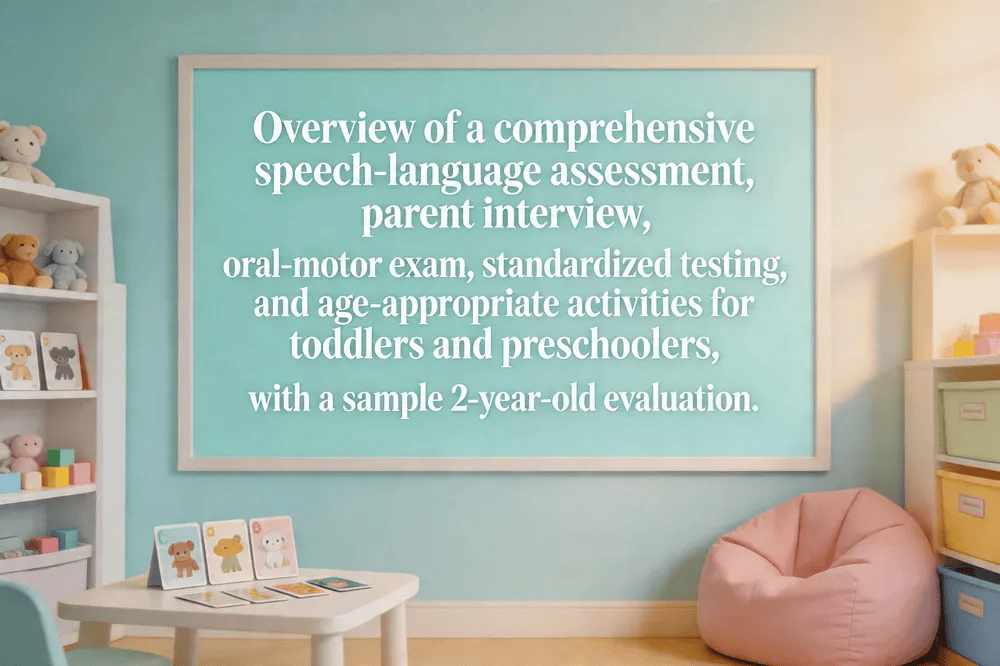
Components of a comprehensive speech‑language assessment A licensed speech‑language pathologist (SLP) begins with a detailed parent interview covering medical, hearing, feeding and communication history. The evaluation includes an oral‑motor exam, play‑based observation, and standardized checks of vocabulary, sentence length, listening comprehension, and speech intelligibility. The SLP also notes pragmatic skills such as turn‑taking and request‑making.Age‑specific evaluation activities for toddlers and preschoolers For toddlers, the clinician uses toys, picture books and simple directions to assess expressive and receptive language. Preschoolers are observed in more complex tasks like storytelling, problem‑solving games and multi‑step directions to gauge grammatical development and social use of language.Speech evaluation for 2‑year‑old A 2‑year‑old evaluation lasts 1‑2 hours, starts with a parent interview, then moves to play‑based activities that test a 50‑100‑word vocabulary, two‑word combos, one‑step commands and basic yes‑no answers. Articulation, intelligibility (~50 % to strangers) and pragmatic behaviors are recorded. Results are compared to age‑appropriate milestones and guide a personalized therapy plan.What is speech therapy for toddlers Therapy is play‑based, embedding sound imitation, word formation and request‑making into games, puzzles and daily routines. The SLP models correct speech, teaches turn‑taking and eye contact, and provides home‑practice strategies for parents.Speech therapy activities for 2‑year‑olds Bubble blowing for breath control, “Simon Says” for action verbs, object‑naming boxes, picture‑book labeling, and nursery‑rhyme singing are all short, fun activities that build listening, vocabulary and oral‑motor skills.Speech therapy for 5‑year‑old at home Combine 10‑15 minutes of articulation drills (e.g., “s‑t‑a‑r”) with story‑telling expansions, interactive apps during snack time, and “I Spy” games for vocabulary. Offer clear choices to motivate speech attempts and practice expectant waiting. Consistency with the SLP’s plan accelerates progress.Will speech therapy help my child talk? Yes. Evidence‑based, individualized, play‑focused therapy improves articulation, language and confidence. Early intervention and regular home practice yield rapid gains, enabling the child to communicate more clearly and effectively.
Therapeutic Approaches and Techniques
Speech therapy techniques for kids Kids thrive on play‑based, evidence‑based methods that blend fun with skill building. Therapists embed modeling and expansion of a child’s utterances into games, picture‑card activities, and rhyming songs. Articulation drills and oral‑motor exercises—such as blowing bubbles, using tongue‑twisters, or blowing a straw—target specific sound production while keeping the child engaged. When speech is limited, augmentative and alternative communication (AAC) tools, including simple sign language or picture‑exchange boards, provide visual supports that bridge gaps and promote interaction.Speech therapy activities for 2‑year‑olds For toddlers, short bursts of activity (5‑10 minutes) work best. Bubble blowing develops breath control while they say “pop” or “bubble.” Turn‑taking games like “Simon Says” encourage listening and action‑word use. During free play, place familiar objects in a box, ask the child to pull one out, name it, and describe its use (e.g., “ball—bounce”). Picture‑rich books, paused for labeling colors, shapes, and animal sounds, and nursery‑rhyme singing with clapping reinforce clear speech and imitation.Speech therapy for toddlers at home Integrate 10‑15‑minute sessions into daily routines—meals, bath time, or car rides. Offer simple choices (e.g., “blocks or bubbles?”) to motivate word use, narrate actions with parallel talk, expand utterances, and use expectant waiting so the child has time to respond. Picture‑card games, sing‑al songs, and basic signs (“more,” “all done”) reinforce vocabulary and sound production. Consistency, guided by a licensed SLP, accelerates progress.Speech therapy for 5‑year‑old at home Blend brief articulation drills (e.g., “s‑t‑a‑r,” “p‑l‑a‑y”) with storytelling where the child expands simple sentences. Use interactive apps or picture cards during snack time, and play “I Spy” games to reinforce rhythm and vocabulary. Offer clear choices and practice expectant waiting. Coordination with the child’s SLP ensures home practice aligns with clinic goals.Speech therapy for 5‑year‑old near me Pediatric Communication Solutions in Oklahoma City provides individualized, play‑based therapy for 5‑year‑olds. Licensed SLPs conduct comprehensive evaluations and create treatment plans that may include in‑clinic, in‑home, or tele‑practice sessions. The clinic collaborates with pediatricians, teachers, and other specialists to deliver coordinated care. Contact the clinic to schedule an assessment and begin supporting your child’s communication development.
Finding the Right Provider in Oklahoma City
When looking for pediatric speech‑language services in Oklahoma City, families have several high‑quality options that blend in‑person care with flexible tele‑therapy. Local clinics such as Pediatric Communication Solutions (P‑) offer state‑licensed speech‑language pathologists who specialize in articulation, language, fluency, voice, and feeding disorders. Their office in the heart of OKC serves a 20‑mile radius, while tele‑practice appointments ensure continuity of care for busy schedules or travel challenges.
P‑ therapists collaborate closely with pediatricians, occupational therapists, and school‑based specialists to create a coordinated, multidisciplinary treatment plan. This partnership extends to Individualized Education Plans (IEPs) and early‑intervention programs, guaranteeing that therapy goals align with classroom expectations and medical recommendations.
Insurance coverage is routine; most private plans, Medicaid, and early‑intervention funding are accepted. Parents can obtain a referral from their child’s pediatrician, school, or directly contact the clinic for a complimentary consultation. Scheduling is streamlined through an online portal or by calling the office, with session frequencies ranging from once weekly to intensive five‑times‑per‑week programs based on the child’s age, disorder severity, and family goals.
Pediatric speech therapy OKC– Our Oklahoma City clinic provides individualized speech‑language evaluation and treatment for children with articulation, language, fluency, and feeding concerns. Licensed and certified speech‑language pathologists create fun, evidence‑based therapy plans that target each child’s unique communication goals while involving families every step of the way. We offer both in‑person and teletherapy options, ensuring consistent progress even when schedules are busy or travel is challenging.Speech therapy Edmond, OK– Pediatric Communication Solutions provides comprehensive pediatric speech‑language therapy for children in Edmond, OK, and nearby communities. Our licensed SLPs offer individualized in‑clinic sessions at our conveniently located office off I‑35, as well as flexible tele‑practice appointments for families who prefer virtual care. Therapy focuses on functional communication goals, including expressive and receptive language, articulation, fluency, pragmatic skills, and augmentative and alternative communication.Pediatric speech therapy near me– If you’re looking for pediatric speech therapy near you in Oklahoma City, Pediatric Communication Solutions offers licensed speech‑language pathologists who specialize in language, speech sound, feeding and learning disorders for children from birth to 21. Our office is conveniently located in the heart of Oklahoma City and we serve families within a 20‑mile radius, including surrounding communities such as Edmond, Norman, and Moore. You can quickly find an available therapist by using our online provider locator or by calling our office, and we will schedule an initial evaluation to create a personalized treatment plan.UCO Speech‑Language Pathology– The University of Central Oklahoma (UCO) offers a Bachelor of in Speech‑Language Pathology and a Master of Science in Speech‑Language Pathology that prepare graduates for Oklahoma licensure and advanced pediatric practice. Graduates are equipped with evidence‑based training, making them ideal candidates for clinics like Pediatric Communication Solutions.Speech Pathology salary – The median annual salary for speech‑language pathologists nationwide was $95,410 in May 2024; in Oklahoma the median is about $66,000, with entry‑level salaries ranging from $57,000 to $71,000 and experienced clinicians earning six‑figure incomes.
Speech therapy helps children develop effective communication skills, improve confidence, enhance academic performance, and build better social relationships.
Supporting Your Child Outside the Clinic
Parental involvement and coaching are cornerstones of successful pediatric speech‑language therapy. Most clinics, including Pediatric Communication Solutions in Oklahoma City, invite parents to sit in sessions, share observations about the child’s preferences and frustration triggers, and learn how to model clear speech and expand utterances during everyday routines. This partnership creates consistency between the therapist’s cues and the child’s natural environment, accelerating motor learning and language growth.
Home‑practice tools and resources make daily practice fun and effective. Short 10‑15‑minute activities—such as picture‑card naming games, sing‑along rhymes, or simple sign‑language prompts—can be woven into meals, bath time, or car rides. Interactive apps (e.g., Articulation Station) and tactile aids like Speech Buddies provide visual and tactile feedback for target sounds. Parents are coached to give two clear choices, use expectant waiting, and celebrate effort, which builds confidence and reinforces skills learned in clinic.
Milestone tracking and printable PDFs give families a clear benchmark. The American Speech‑Language‑Hearing Association (ASHA) offers downloadable age‑specific speech‑and‑language milestone checklists from birth through five years, and Pediatric Communication Solutions provides a mirrored PDF guide with tips for Oklahoma families. Regularly reviewing these charts helps parents spot red‑flag behaviors early and discuss progress with the SLP. In short, an engaged parent, a well‑structured home program, and easy‑to‑use milestone resources together create a supportive ecosystem that maximizes the child’s communication outcomes.
Putting It All Together
Early signs such as limited babbling by 6‑12 months, a vocabularies under 50 words by age 2, or difficulty forming two‑word phrases by age 3 should prompt a pediatrician referral for a speech‑language evaluation. An SLP will interview parents, observe play, and use standardized tests to assess articulation, language, fluency, voice, and oral‑motor skills. Therapy options range from play‑based games and interactive story‑time to motor‑speech approaches for apraxia, delivered in‑person, via telehealth, or in hybrid models. Parents are essential partners: modeling correct speech, providing daily reading and conversation, using flashcards or apps, and reinforcing home‑practice activities suggested by the therapist. Consistency between clinic work and everyday routines accelerates progress and builds confidence. Pediatric Communication Solutions in Oklahoma City offers a child‑centered, evidence‑based program that begins with a comprehensive evaluation, creates individualized goals, and provides flexible scheduling—including evening and weekend slots—to meet family needs. The clinic’s licensed SLPs coach caregivers, track measurable outcomes, and collaborate with medical specialists, ensuring each child receives coordinated support for speech, language, feeding, and literacy development.